Arbitrage Alerts: Unearthing Surebets Amid Shifting Multi-Site Odds
Leon Lang · Mar 21, 2026

Arbitrage Alerts: Unearthing Surebets Amid Shifting Multi-Site Odds
The Odds Maze: Where Discrepancies Breed Profit Opportunities
Bookmakers worldwide set their own lines on the same events, pulling from data feeds, public sentiment, and proprietary models, which often leads to temporary mismatches; these gaps, known as arbitrage opportunities or surebets, emerge when the combined implied probabilities from opposing outcomes fall below 100 percent, guaranteeing a profit if bets place across sites before lines adjust. Observers note that such variances spike during high-volume events like major soccer leagues or NBA playoffs, where liquidity floods in unevenly, creating chaos ripe for exploitation. Data from scanning services reveals average surebet margins hover around 1-2 percent, but peaks hit 5 percent or more in niche markets like esports or lower-tier tennis.
Turns out, manual hunting proves exhausting; bettors once scoured sites by hand, jotting odds in spreadsheets, yet automation changed everything with real-time arbitrage alerts that ping users the moment a surebet appears. Software developers built these tools by aggregating feeds from 50-100 bookmakers, crunching numbers via algorithms that calculate stake allocations for risk-free returns, alerting via apps, emails, or browser extensions almost instantly.
What's interesting is how live betting amplifies this; in-play odds fluctuate wildly as games unfold, birthing micro-surebets lasting seconds, and those who deploy alerts catch them before adjustments wipe them out. One case involved a Premier League match in early 2025 where halftime odds diverged enough for a 1.8 percent arb between Bet365 and Pinnacle, netting savvy users quick gains before the bookies synced up.
Decoding Surebets: The Math Behind Guaranteed Wins
A surebet exists when betting equal proportional stakes on all outcomes yields profit regardless; for a two-way market like tennis, if Bookmaker A offers 2.05 on Player X and Bookmaker B lists 2.05 on Player Y, the implied probabilities (1/2.05 ≈ 48.78 percent each) sum to 97.56 percent, leaving 2.44 percent edge for the bettor. Experts calculate stakes via the formula: stake on outcome = (total investment × implied prob of other) / sum of implied probs, ensuring even payouts; in practice, tools handle this, spitting out exact amounts like €57.44 on A and €42.56 on B for €100 total, returning €105 either way.
But here's the thing: multi-outcome events like soccer (1X2 markets) complicate it further, demanding precision across three books perhaps, yet alerts parse these seamlessly, flagging only viable plays after factoring commissions or Asian lines. Research from Pinnacle's betting resources indicates that while simple two-ways dominate 70 percent of alerts, three-ways surge during internationals, offering juicier but riskier edges.
People who've mastered this often start small, testing with middling stakes to build volume; one observer tracked 200 surebets over a month, turning €10,000 into €12,400 at 1.2 percent average yield, compounding steadily without single-event exposure.
Arbitrage Alert Tools: Scanners That Never Sleep
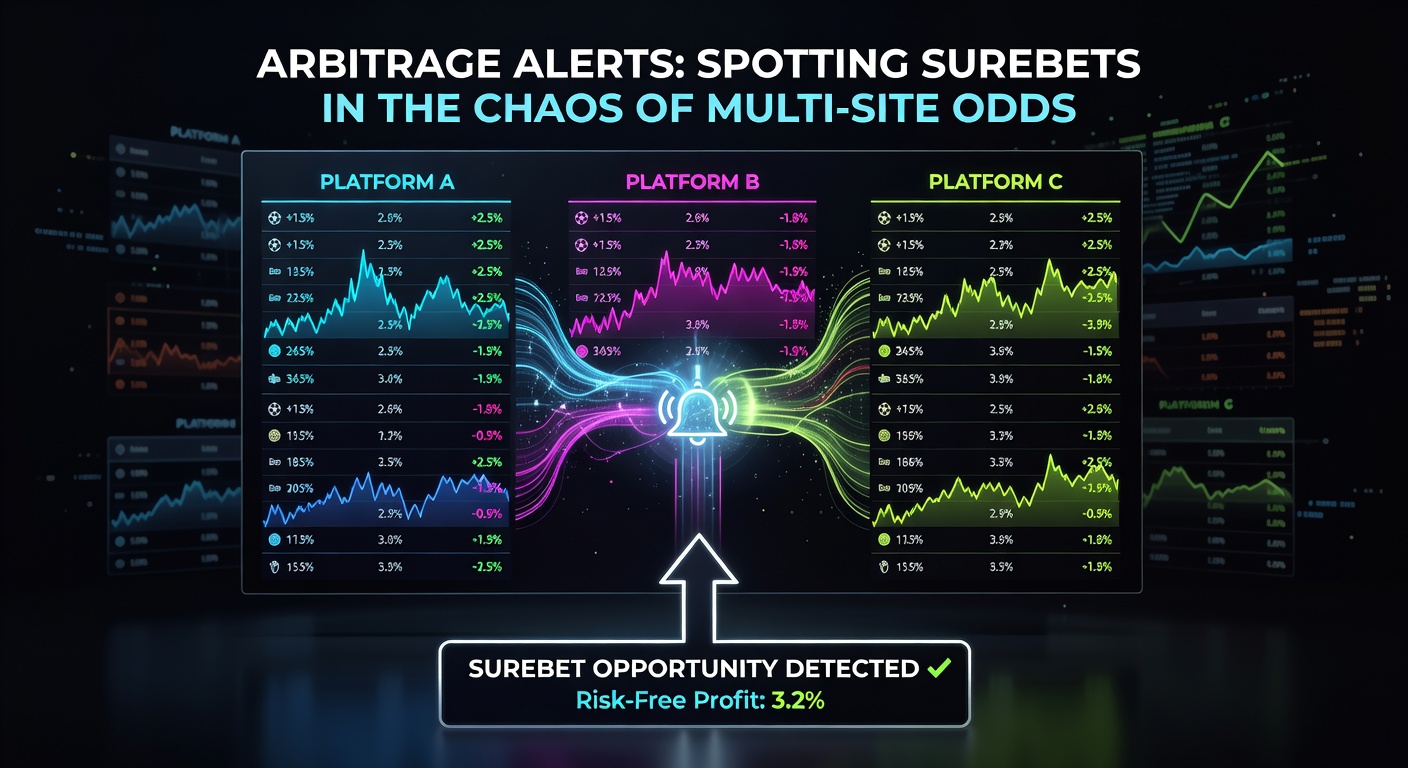
Services like BetBurger, RebelBetting, and OddsJam lead the pack, scanning hundreds of books continuously; they filter by sport, margin threshold (say, over 1 percent), and even account-specific limits, pushing alerts ranked by profitability and ease of execution. Users subscribe monthly, gaining dashboards that log history, simulate stakes, and warn of middles—overlapping ranges promising double profit if both hit.
So how do they work under the hood? Aggregators pull XML/JSON feeds legally available to affiliates, cross-reference via APIs, and deploy cloud servers for sub-second calculations; free trials let newcomers verify hits, but premium tiers unlock pre-match, live, and value bets. Figures show top scanners detect 100-500 surebets daily per user, though only 20-30 percent prove executable after delays or geo-blocks.
Yet adaptation rules the day; bookmakers deploy counter-AI now, pattern-matching arbers via bet clusters, which explains why alerts increasingly prioritize "stealth" plays on obscure leagues or via VPNs. In Australia, where regulations tightened in March 2026 under the Queensland Office of Liquor and Gaming Regulation, scanners adjusted feeds to comply, filtering licensed AU books while highlighting international arb paths.
Take a basketball example: During March Madness 2025, an alert fired for Duke vs. Gonzaga where FanDuel offered +150 on Duke, DraftKings -165 on Gonzaga elsewhere, but wait—no, precise arb hit when a third site lagged at 2.15 reciprocal, yielding 1.5 percent; users split stakes €200/€300/€100 across three, banking €103 profit post-vig.
Risks and Realities: Bookie Pushback in the Arb Game
Bookmakers loathe arbers, viewing them as unprofitable despite recreational focus; they stake-limit, void bets, or close accounts when patterns emerge—data indicates 30-50 percent of serious arbers face restrictions within six months, forcing rotations across 20+ sites. Observers track "gubbing" tactics like bonus abuse flags or IP bans, yet round-robining stakes and mixing recreational bets prolongs viability.
That's where the rubber meets the road: exchange platforms like Betfair shine, offering lay bets for self-arbs, immune to closures since users set the odds; combined with traditional books, hybrids boost opportunities by 40 percent according to scanner stats. Legality holds firm in most jurisdictions—no laws ban arb itself, as it's pure math—but terms of service violations invite backlash; the Nevada Gaming Control Board, overseeing US sportsbooks, emphasized in 2025 reports that while player protections prioritize fairness, aggressive account management remains bookie prerogative.
Exchange rates, withdrawal delays, and currency conversions nibble edges too, dropping net yields below 1 percent sometimes; those who thrive diversify sports, cap exposure per book, and heed alerts' "value rating" filtering low-liquidity traps where bets reject mid-placement.
Now consider middles, a cousin to surebets: when lines cross like NFL totals at 47.5/48, betting both sides wins if extreme scores hit; alerts bundle these, turning chaos into layered profits, though rarer at 0.5 percent daily frequency.
Scaling Up: From Alerts to Portfolio Strategies
Advanced users build portfolios, allocating bankrolls across scanner types—live for volume, pre-match for size—while APIs integrate bots for auto-betting where legal, like certain EU exchanges. Case studies reveal pros netting 20-50 percent annual ROI on €50k+ rolls, but consistency demands discipline; one tracked group averaged 1.1 percent per bet over 5,000 plays, weathering dry spells via value overlays.
Esports and virtuals emerge as frontiers, with fragmented Asian books yielding 3+ percent arbs amid thin oversight; yet as AI evens the field, March 2026 saw US platforms like those under New Jersey oversight ramp detection, per industry filings, pushing arbers toward global diversification.
It's noteworthy that communities share "dead bookie" lists, fostering resilience; newcomers learn fast by paper-trading alerts, grasping why speed and stake precision separate dabblers from earners.
Wrapping the Odds: Surebets in Today's Landscape
Arbitrage alerts transform multi-site chaos into accessible edges, delivering factual paths to risk-free gains amid ever-shifting lines; while bookie countermeasures evolve, tech-savvy bettors persist by rotating, hybridizing, and staying alert—literally. Data underscores viability for those methodical, with margins persisting despite scrutiny, ensuring surebets remain a cornerstone tactic in sophisticated betting arsenals. As markets globalize further into 2026, scanners adapt, keeping the hunt alive for anyone decoding the discrepancies.