Cognitive Biases Driving Risk Assessment in Multi-Player Digital Card Tournaments
Vera Flores · Aug 19, 2026
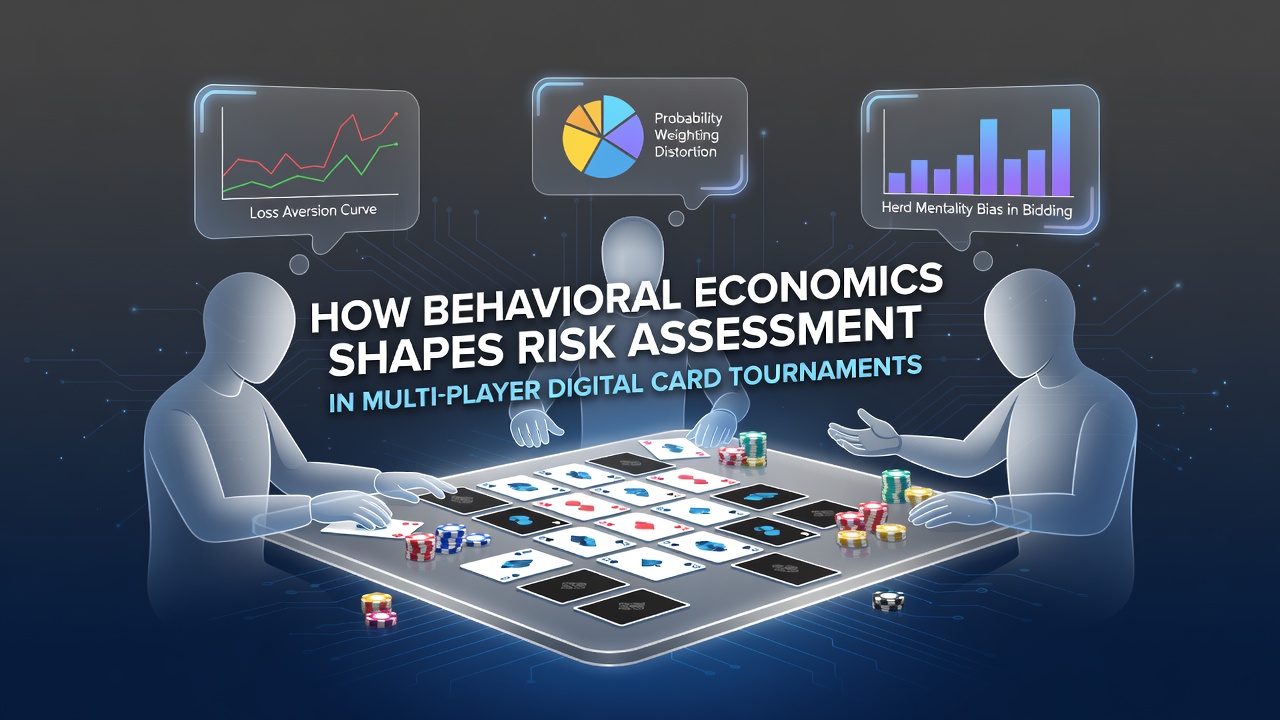
Cognitive Biases Driving Risk Assessment in Multi-Player Digital Card Tournaments
Multi-player digital card tournaments present structured environments where participants evaluate probabilities, manage resources, and respond to opponents in real time, and behavioral economics provides frameworks that explain systematic patterns in these choices. Researchers have documented how concepts such as prospect theory and loss aversion shape the way players weigh potential gains against losses during betting rounds and all-in decisions.
Core Concepts from Behavioral Economics Applied to Card Play
Prospect theory, developed through experimental work in the late twentieth century, demonstrates that individuals tend to overweight losses relative to equivalent gains, which leads tournament participants to adopt more conservative strategies after early setbacks. In online formats where chip stacks update instantly, this bias can prompt players to fold marginal hands more frequently once they have lost a portion of their starting allocation. Data from large-scale platform analytics indicate that fold rates rise measurably following consecutive losses, even when pot odds remain favorable.
Overconfidence bias appears when skilled players overestimate their edge against the field. Studies tracking thousands of tournament entries reveal that participants with moderate win rates often accept higher-variance lines, such as large pre-flop raises with suited connectors, because prior successes inflate perceived control. Platforms record these patterns through hand histories, allowing analysts to quantify deviations from expected value calculations derived from game theory optimal solvers.
Loss Aversion and Stack Management Patterns
Loss aversion influences how competitors protect remaining chips late in events. When blinds increase and payout structures tighten, many players exhibit reluctance to commit stacks unless they hold premium holdings, a tendency that narrows their range beyond mathematical recommendations. Observers note this effect intensifies in sit-and-go formats where the difference between min-cash and final-table payouts becomes salient on screen.
One analysis of European online poker networks conducted in 2025 showed that average stack preservation metrics deviated from equilibrium models by approximately 12 percent in the middle stages of multi-table tournaments. These deviations correlated with visual representations of chip counts rather than absolute monetary values, illustrating how digital interfaces can amplify reference-point effects.
Anchoring Effects During Rapid Decision Windows
Anchoring occurs when initial information, such as an opponent's early raise size or a displayed pot total, serves as a reference point for subsequent judgments. In fast-fold or zoom poker variants, where decision timers limit deliberation, players frequently adjust their calling ranges relative to the first number presented rather than recalculating independent probabilities. Tournament software logs demonstrate that call frequencies stabilize around anchored values even after multiple rounds of action alter the underlying odds.

Researchers at the American Economic Association have examined similar anchoring in laboratory replications of Texas hold'em scenarios, confirming that exposure to arbitrary numerical cues shifts risk thresholds measurably within short time frames. Tournament operators have begun incorporating randomized display orders for certain statistics to mitigate these influences.
Social Proof and Herding in Shared Table Dynamics
Multi-player settings introduce social proof mechanisms where observed actions of others guide individual risk assessments. When several participants limp into a pot or call a moderate bet, remaining players show increased likelihood of joining rather than folding, even when their own cards do not justify participation. Platform heat maps from August 2026 releases indicate clustered calling patterns across geographically distributed tables during peak evening hours.
Herding intensifies near bubble stages because visible survival of others reinforces the perception that conservative play yields positive expected outcomes. Data aggregated across North American and Australian sites reveal synchronized fold rates that exceed independent player models by noticeable margins during these pressure periods.
Implications for Tournament Design and Player Tools
Platform developers have responded by integrating decision-support overlays that present normalized ranges alongside personal historical tendencies. These tools aim to counteract common biases without removing player agency. Regulatory bodies in multiple jurisdictions, including those overseeing licensed digital gaming in Canada, have reviewed such features for compliance with responsible play standards.
Continued collection of anonymized hand data allows researchers to refine models that separate skill-based adjustments from bias-driven deviations. As tournaments evolve with new formats and augmented reality interfaces, the interaction between interface design and cognitive patterns remains a focal area for empirical investigation.
Conclusion
Behavioral economics supplies measurable constructs that map onto observable decisions within multi-player digital card tournaments. Loss aversion, overconfidence, anchoring, and herding each produce predictable shifts in risk assessment that platform data capture at scale. Ongoing analysis of these patterns supports both academic understanding and operational adjustments in tournament environments.