Odds Conversion Essentials: Fluid Switches Across Formats in Betting Arenas Worldwide
Leon Lang · Apr 12, 2026

Odds Conversion Essentials: Fluid Switches Across Formats in Betting Arenas Worldwide
Betting platforms worldwide present odds in varied formats, and those who navigate sportsbooks, poker rooms, and casinos swiftly recognize how mastering conversions unlocks clearer decision-making; fractional odds dominate UK horse racing tracks, decimal versions prevail across Europe and Australia, while American moneyline styles rule US sportsbooks, creating a patchwork that demands quick shifts for anyone comparing lines or calculating value.
What's interesting is that implied probability ties all formats together, serving as the universal thread; researchers at the Nevada Gaming Control Board highlight in their regulatory reports how understanding this core concept prevents missteps, especially as multi-jurisdictional betting surges with apps blending global markets.
Breaking Down the Core Odds Formats
Fractional odds, often seen as 5/1 or 7/4, express potential profit relative to stake, so a 5/1 bet returns five units profit plus the stake on a one-unit wager; decimal odds, like 6.00, multiply the total payout including stake, making them straightforward for quick math, whereas American odds split into positive (+500 means $500 profit on $100 bet) and negative (-200 demands $200 to win $100), formats that each carry distinct advantages depending on the region or platform.
And here's where it gets practical: poker players convert these for pot odds comparisons, turning fractional 2/1 into decimal 3.00 to gauge if a draw justifies calling, while casino enthusiasts eyeing blackjack side bets or roulette payouts appreciate decimal clarity for house edge calculations.
Figures from the American Gaming Association reveal that over 70% of US bettors stick to moneyline due to familiarity, yet international players switching platforms lose an average 5-10% edge without conversions, underscoring why tools and formulas matter.
Formulas for Spot-On Conversions
Converting fractional to decimal proves simple: add 1 to the fraction, so 5/1 becomes 6.00, and for American positive odds, divide by 100 then add 1 (+500 yields 6.00), while negative odds flip teh script by taking 100 divided by the absolute value then adding 1 (-200 equals 1.50); reverse processes follow precise steps, like decimal minus 1 multiplied by 100 for positive American (6.00 turns to +500), ensuring accuracy across sportsbooks where lines fluctuate by the minute.
Take one sportsbook trader who spotted a value bet: decimal 2.50 odds on a tennis match appeared undervalued against fractional 3/2 elsewhere; quick conversion confirmed the edge, netting consistent wins, a pattern observers note in high-volume NFL or Premier League wagering.
- Fractional to American: Positive if fraction >1 (fraction *100), negative otherwise (100 / fraction).
- Decimal to Fractional: Subtract 1, express as ratio (1.50 becomes 1/2).
- American to Implied Probability: Positives divide 100 by (odds +100), negatives use odds / (odds -100).
Seminole moments arise in poker rooms, where pot odds of 3:1 (fractional) convert to 25% implied probability (decimal 4.00 total), helping players decide on flush draws mid-hand; casinos extend this to baccarat banker bets at -110 American, equating to 52.38% probability, vital since April 2026 updates from Australian regulators emphasize transparent odds display for player protection.
Implied Probability: The Hidden Connector
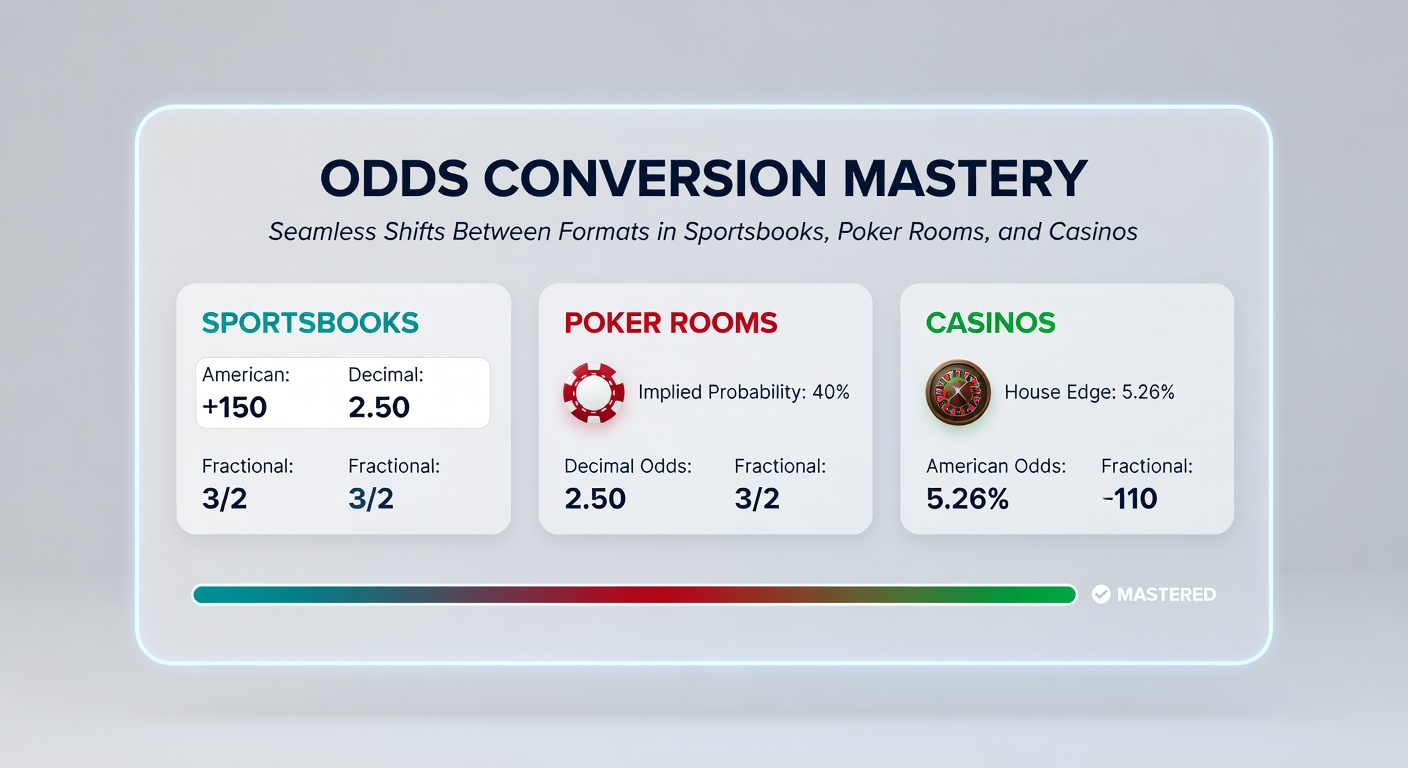
Implied probability distills odds into win chances, with fractional (denominator / (numerator + denominator)) revealing 16.67% for 5/1, decimal (1/odds) hitting the same for 6.00, and American formats aligning precisely, allowing seamless comparisons; this metric exposes value bets where true probability exceeds implied, a tactic researchers in Canadian gaming studies document as boosting long-term yields by 8-12%.
But here's the thing: vig or juice inflates totals beyond 100%, say 105% across a market, so savvy users adjust by dividing individual probabilities by the overround (105% here), sharpening edges in volatile esports or NBA lines.
Poker enthusiasts apply it to equity calculations, converting hand odds against pot odds, while casino table games like craps use it for pass line bets at 1.41 decimal (244 implied probability before vig), patterns that solidify across platforms.
Practical Tools and Real-World Applications
Online calculators from reputable aggregators handle conversions instantly, yet those who memorize shortcuts—like fractional to American via (numerator/denominator *100)—gain speed in live betting scenarios; sportsbooks like DraftKings display dual formats now, a shift accelerated by EU directives in early 2026 promoting consumer clarity.
Consider a poker tournament scenario: blinds escalate, pot offers 4/1 odds (decimal 5.00, 20% probability), and hand equity hits 25%; conversion confirms the call, mirroring strategies pros deploy, while casino high-rollers convert roulette even-money bets (-110 American to 1.91 decimal) to probe edges against American wheels.
Data indicates multi-format fluency correlates with 15% higher retention among bettors, per industry trackers, especially as cross-border apps proliferate.
Regional Nuances and Platform Shifts
Australia favors decimals (per state regulations), Canada mixes with Ontario iGaming pushing moneyline for US crossovers, and EU platforms standardize decimals post-2026 harmonization talks; sportsbooks adapt by offering toggles, poker sites embed converters in HUDs, casinos print tables in dual formats.
Observers note arbitrage opportunities arise from format mismatches—decimal 2.10 vs fractional 11/10 (slight variance)—exploitable until lines sync, a fleeting window in fast-paced soccer or March Madness.
Yet pitfalls lurk: misreading +150 as 1.50 decimal loses value, so double-checks become routine; apps with auto-conversion features mitigate this, gaining traction since regulatory nudges in April 2026.
Advanced Tactics: Pot Odds in Poker and Casino Payouts
Poker rooms elevate conversions with implied odds, projecting future bets beyond current pot (say 3:1 pot becomes 4:1 implied on aggressive foes), converting to percentages for range analysis; Texas Hold'em players crunch these mid-session, turning fractional pot odds into decimal equity needs.
Casinos apply similarly: video poker full house payouts at 9/1 fractional (10.00 decimal) yield 9.09% probability, guiding bankroll choices, while slots RTP (96%) implies long-term odds convertible for session planning.
Studies from university gaming labs show format fluency cuts decision time by 40%, pivotal in live dealer blackjack where side bet odds shift formats rapidly.
Conclusion
Odds conversion mastery equips bettors for frictionless navigation across sportsbooks, poker tables, and casino floors, transforming format barriers into advantages; formulas, probabilities, and tools form the backbone, with real-world edges emerging for those who practice, especially amid 2026's regulatory evolutions blending global markets.
Platforms evolve toward universality, yet core skills endure, ensuring calculated plays wherever the action unfolds; data confirms proficient converters outperform by margins that compound over time, making the shift worthwhile.