Sentiment Analysis Tools Drive Real-Time Decisions in Offshore Poker Tournaments
Jordan Schmid · Aug 19, 2026

Sentiment Analysis Tools Drive Real-Time Decisions in Offshore Poker Tournaments
Offshore poker tournaments operate across multiple time zones and jurisdictions where platforms integrate sentiment analysis tools to process player interactions in real time, and these systems examine chat messages, bet timing patterns, and voice inflections when available to generate emotional profiles that inform strategic adjustments mid-hand. Data from such tools flows into dashboards used by players and support teams, while the underlying algorithms draw on natural language processing models trained on large sets of poker-specific dialogue collected from previous events.
Core Mechanisms Behind the Tools
Algorithms classify text inputs into categories such as frustration, confidence, or hesitation, and they assign numerical scores that update continuously throughout each round. Platforms based in regions including Malta and Curacao have incorporated these features into their tournament software since early 2025, and the updates allow observers to track shifts in sentiment across hundreds of simultaneous tables. When a player types phrases indicating doubt after a large bet, the system flags the table for closer monitoring, while rapid consecutive bets paired with neutral language may trigger alerts for potential aggression patterns.
Integration with timing data adds another layer, since delays between actions often correlate with emotional states according to research compiled by the iGaming Research Consortium. Tournament directors receive aggregated reports rather than individual profiles, which helps maintain compliance with data protection rules in offshore licensing frameworks.
Application During Live Events
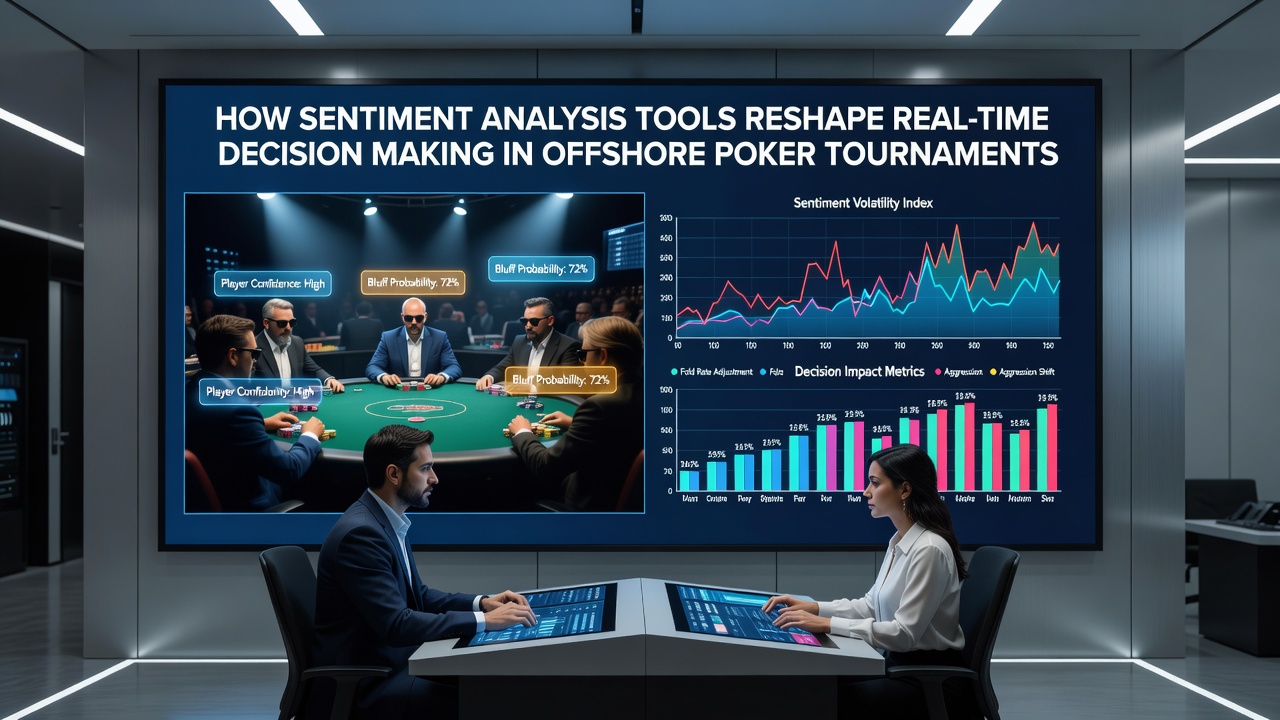
In August 2026 several major offshore series introduced live sentiment overlays for accredited teams, and these overlays display color-coded indicators next to player avatars without revealing raw data to the broader field. Players who subscribe to premium analytics packages receive private summaries that highlight opponents showing elevated stress markers after losing consecutive pots. Such information supports decisions on whether to apply pressure in subsequent hands or to fold marginal holdings when sentiment scores suggest resilience in the opposing range.
One documented case involved a mid-stakes event where a European-based team adjusted its continuation betting frequency after the tool indicated rising frustration levels in two key opponents, and the adjustment contributed to an improved stack position by the final table. The same platforms also log historical sentiment trends across multiple tournaments, allowing participants to build opponent databases that extend beyond traditional statistics like VPIP and aggression factor.
Data Sources and Regulatory Context
Offshore operators source training data from anonymized tournament logs that exclude personally identifiable information, and independent audits verify that processing stays within the scope permitted by each licensing authority. A report issued by the Canadian Gaming Integrity Institute examined adoption rates through mid-2026 and found that roughly 18 percent of offshore MTT platforms had deployed some form of real-time sentiment module. The same document noted that detection accuracy improves when voice data from streamed tables supplements text analysis, though many events still rely primarily on written chat because of bandwidth constraints in certain regions.
Those who manage tournament integrity programs review sentiment outputs to identify potential collusion signals, such as coordinated emotional language between accounts, and they cross-reference these signals with bet sizing anomalies. This dual-use capability explains why licensing bodies in multiple Caribbean jurisdictions now require operators to maintain logs of all sentiment outputs for a minimum of 90 days.
Limitations and Ongoing Developments
Sentiment models occasionally misclassify sarcasm or cultural phrasing common in international player pools, and developers continue to refine multilingual datasets to reduce error rates. Platforms address these gaps by combining sentiment scores with established metrics such as fold-to-three-bet percentages, thereby creating hybrid indicators that carry greater weight in decision support systems. Observers note that the most effective implementations treat the output as one data point among many rather than as a standalone predictor.
Future iterations scheduled for late 2026 aim to incorporate facial micro-expression detection from optional webcam feeds, yet current regulations in most offshore locations still prohibit mandatory video capture during play. Teams that already use the existing tools report faster adaptation to table dynamics, particularly in late-stage bubble situations where emotional volatility tends to increase across the field.
Conclusion
Sentiment analysis has become embedded in the operational infrastructure of offshore poker tournaments because it supplies structured emotional context to complement numerical statistics. Platforms continue to expand these capabilities while regulatory frameworks evolve to address data handling and competitive fairness. The result is a decision-making environment where real-time signals influence strategy at a granular level, and the pace of integration shows no sign of slowing through the remainder of 2026 and beyond.