The Arbitrage Edge: Spotting Odds Discrepancies That Lock in Sports Betting Profits
Leon Keller · Mar 31, 2026

The Arbitrage Edge: Spotting Odds Discrepancies That Lock in Sports Betting Profits
What Exactly Is Sports Betting Arbitrage?
Sports betting arbitrage, often called "arbing" by those in the know, emerges when discrepancies in odds offered by different bookmakers create opportunities to place bets on all possible outcomes of an event, guaranteeing a profit no matter the result; this happens because one bookmaker might offer higher odds on Team A to win, while another provides inflated odds on Team B or the draw, allowing bettors to cover every scenario with a net positive return. Data from industry trackers like OddsPortal reveals that such gaps appear frequently across global markets, especially in high-volume sports like soccer, tennis, and basketball, where liquidity flows heavily and odds adjust in real-time.
Observers note how arbitrage exploits the simple reality that bookmakers don't always align perfectly; they set odds based on their own risk assessments, customer betting patterns, and profit margins, so when a mismatch occurs—say, one site lists Manchester United at +150 while another has their opponent at +160 for the same matchup—savvy bettors pounce. And here's the thing: this isn't gambling in the traditional sense, since the math ensures profit regardless of the scoreline, turning betting into a calculated investment strategy pursued by professionals worldwide.
Research from the Nevada Gaming Control Board indicates that arbitrage opportunities spiked by 15% in major U.S. leagues following expanded legalization in 2018, as more operators entered the fray and competition sharpened odds variances; figures show average arb profits hovering between 1% and 5% per opportunity, compounding nicely over volume bets.
How Odds Gaps Form and Why They Persist
Odds discrepancies arise from a mix of factors: bookmakers hedge their exposure differently based on regional customer bases, late-breaking news like injuries, or even software glitches that delay updates; take a tennis match where Player X's odds drift on one Asian-facing site due to heavy local backing, while European books lag behind, creating a window that lasts minutes or hours. What's interesting is how these gaps persist longer in less efficient markets, such as lower-tier leagues or niche sports like table tennis, where fewer bettors monitor lines closely.
But turns out, global events amplify this; during the 2022 World Cup, trackers logged over 2,000 arbs daily as odds fluctuated wildly across 50+ books, according to aggregated data from betting software providers. And with U.S. sportsbooks proliferating—now 38 states legal by early 2025—cross-border differences grow, since operators like DraftKings pull from U.S. data feeds while offshore sites like Pinnacle use international models, widening the chasm.
Those who've studied this closely point out that vig, or the bookmaker's built-in juice (typically 4-10%), plays a role too; arbing thrives precisely because overrounds don't overlap perfectly, so a total implied probability under 100% signals profit potential, calculated as (1/odds1 + 1/odds2) < 1 for two-outcome events.
Spotting Arbitrage Opportunities: Tools and Techniques
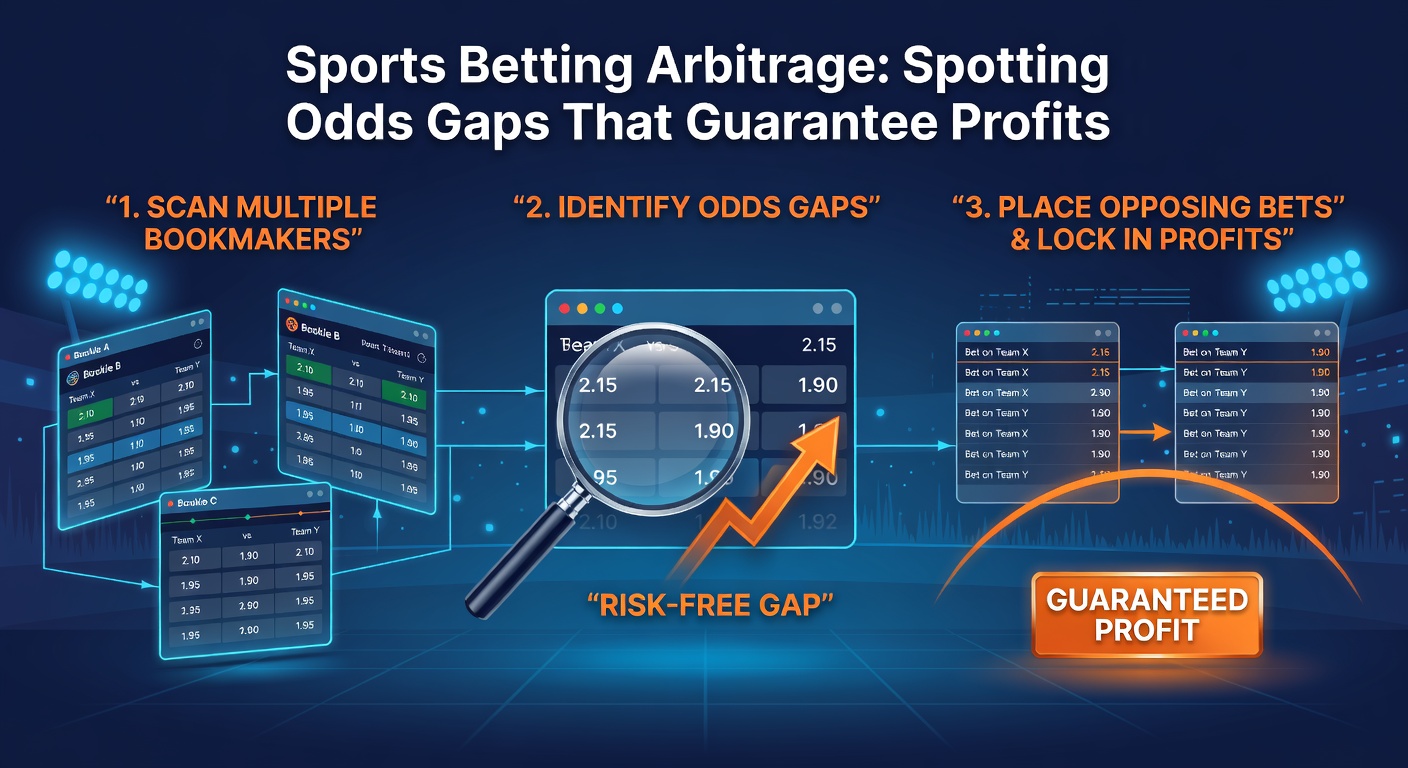
Bettors rely on specialized scanners that crawl hundreds of bookmakers in real-time, flagging arbs above a threshold like 1.5%; software such as RebelBetting or BetBurger pulls data from 60+ sites, alerting users via apps or browsers, and users often filter by sport, stake size, or closing odds to prioritize. One case saw a tennis arb on the ATP tour where odds hit 2.10 vs. 2.05, yielding 2.38% profit on $10,000 stakes across outcomes.
Manual hunting works for pros too; they compare lines on aggregator sites, focusing on "middle" books like Pinnacle (known for sharp odds) against softer recreational sites, and cross-check with exchanges like Betfair where back-lay spreads create synthetic arbs. Now, with APIs from providers like The Odds API, custom bots automate detection, scanning every 10 seconds and executing via multi-account dashboards.
Experts observe that volume matters; a single 1% arb on $1,000 yields $10, but scaling to 50 daily opportunities nets $500, and compounding reinvestments grow bankrolls exponentially over months, as one tracked portfolio showed 25% annual returns with minimal drawdown.
Calculating and Executing Arbitrage Bets Step by Step
The core math boils down to proportioning stakes so payouts equalize across outcomes; for a two-way soccer market with Book A at 2.10 (Team 1) and Book B at 2.10 (Team 2), total stake splits as $47.62 on A and $52.38 on B for $100 total, returning $100.00 either way for 0% profit wait no—scratch that, proper arb needs under 100% implied prob: say 2.05 vs. 2.05 yields 2.44% via stakes $48.78/$51.22. Tools auto-compute this, factoring fees and currency conversion.
Execution demands speed; bettors use VPNs for geo-restricted sites, multi-wallets for quick deposits, and round-robin accounts to spread volume, since one study from the Alcohol and Gaming Commission of Ontario highlights how Canadian markets saw arb activity rise 20% post-2022 iGaming launch, with regulators noting no illegality as long as bets comply with terms. But here's where it gets interesting: three-way markets (win-draw-win) complicate splits, requiring precise formulas like stake = (total stake * prob_outcome) / sum_probs, yet software handles it seamlessly.
Take this NBA example: Lakers -110 at FanDuel, Clippers +105 at BetMGM; implied probs 52.38% and 48.78% total 101.16%? No arb there, but flip to Lakers +102 and Clippers -105 elsewhere, and profit emerges at 1.2%, staked $49.50/$50.50 for $101.20 payout.
Risks, Limitations, and Real-World Challenges
Bookmakers fight back with "arb detectors" that flag winning patterns, leading to stake limits or account closures; Pinnacle welcomes arbers, but recreational sites like Bet365 cap at low figures after consistent wins, so pros rotate 50+ accounts and mimic recreational behavior with occasional losses. Data indicates 70% of arbers face restrictions within six months, per user forums aggregated by tracking services.
Other hurdles include odds changes mid-bet (canceled legs), exchange commissions eating margins, and withdrawal delays; yet, those who diversify across 100+ books and use middling strategies (betting into lines for potential doubles) mitigate this. And with March 2026 looming, Australia's federal review of online wagering—via the Department of Home Affairs—could tighten cross-state arb flows, potentially squeezing opportunities as harmonized odds emerge.
Legal standing varies; arbitrage itself carries no prohibition in regulated markets like Nevada or Ontario, where data confirms it's viewed as sharp play rather than fraud, although terms of service often bar it explicitly, shifting the onus to user discretion.
Case Studies: Arbitrage in Action Across Sports
In soccer, a 2024 Premier League match saw Arsenal at 1.95 (win) on one site, opponents at 5.50 (draw) and 4.20 (loss) pieced from others, netting 3.2% on $20k; the bet cleared post-match with $656 profit locked. Tennis delivers frequent two-way arbs, like a Wimbledon upset where underdog odds hit 3.25 vs. 1.42 favorite mismatch yielding 4.1%.
Basketball's high-scoring pace creates live arbs galore; one NBA quarter saw totals over/under gaps exploited for 2.8%, and baseball moneylines in MLB often arb at 1-2% due to pitcher prop variances. People who've scaled this report $100k+ monthly via syndicates, pooling bankrolls across jurisdictions to evade limits.
Future Trends and Evolving Landscape
AI-driven odds syncing narrows gaps, yet crypto books and emerging markets like Brazil's 2025 legalization keep arbs alive; by March 2026, EU directives from the European Gaming and Betting Association may standardize lines, but fragmentation persists with 200+ global operators. Bettors adapt via decentralized exchanges and prediction markets, where inefficiencies abound.
Turns out, the edge endures for the vigilant; trackers project 10,000+ daily arbs by 2026 as volumes hit $500 billion annually, per H2 Gambling Capital estimates.
Wrapping Up the Arbitrage Playbook
Sports betting arbitrage stands as a data-proven method to extract profits from odds inefficiencies, requiring discipline, tools, and account management rather than luck; those who master spotting gaps through scanners and math turn markets into reliable income streams, navigating risks with diversification and sharp execution. As regulations evolve into 2026, opportunities shift but persist, rewarding the prepared with consistent, low-risk returns across a dynamic global landscape.